Inquire (

 HOME
Design Your Own Jewelry Packaging: From Idea to Testable Brief
 Nov 10,2026

 BOYANGPACK
A beautiful reference image is useful, but it cannot show whether your jewelry fits or how the package behaves when opened. Design your own jewelry packaging by choosing a clear brand direction, testing the jewelry fit, and documenting every component. The result should be a brief that a supplier can sample and a buyer can approve, rather than a collection of unrelated visual preferences.
Choose One Direction Before Choosing Finishes
Write a short statement about the experience the packaging must create. Is the main use a counter presentation, a gift, an online delivery, or a keepsake for storage? Choose one primary situation, because the box's role changes with the moment. A retail display may need an immediate view of the piece, while an online order also needs a sensible way to sit inside a protective shipper.
Select a small set of visual decisions that belong to the brand: color family, logo prominence, surface character, and the relationship between box and insert. A precise direction is more useful than asking for every available finish. A restrained box can still feel intentional if the proportions and opening support the jewelry. An elaborate surface does not rescue a loose insert or an awkward closure.
Gather references and label what each one communicates. One image might show a suitable drawer opening; another might show the desired color or logo size. State which features are references only. The supplier should not have to guess that every aspect of a photograph must be reproduced. Avoid copying another brand's graphics or distinctive layout; translate the underlying function into your own design language.
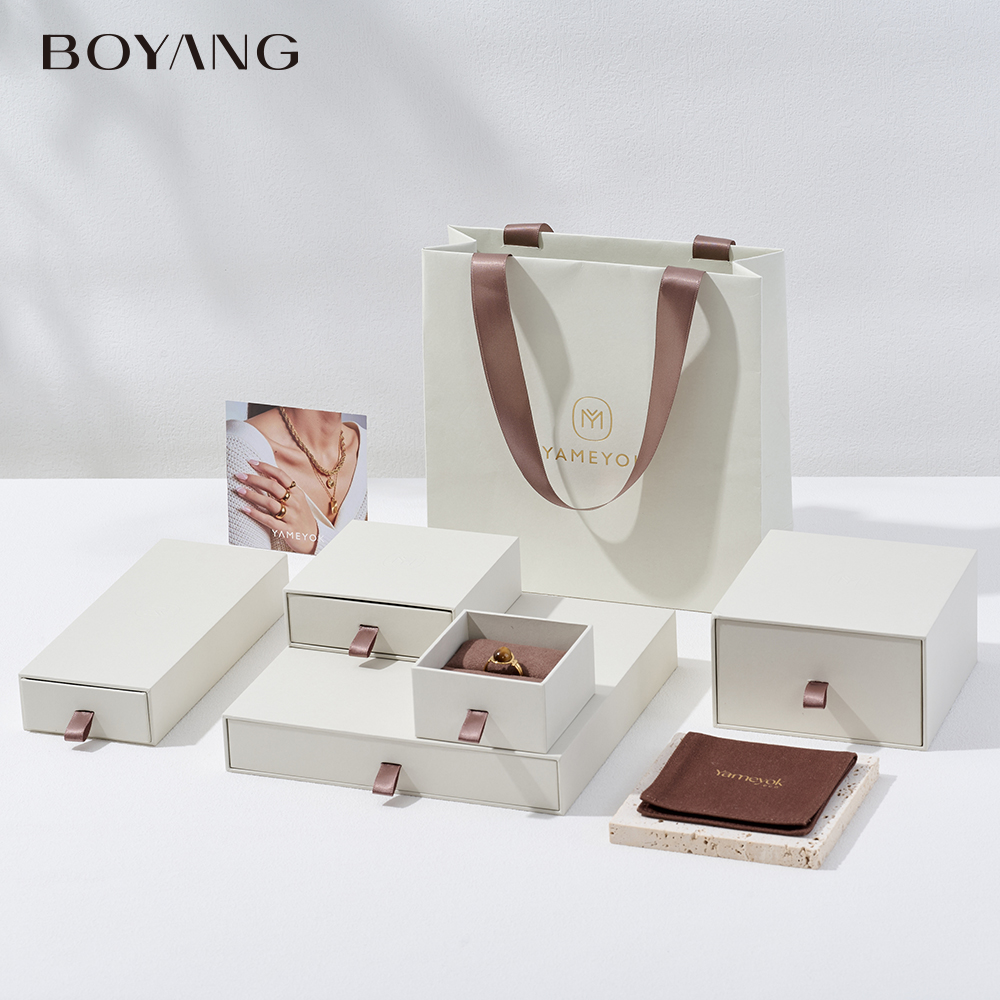
Boyang's jewelry packaging set page shows boxes, bags, and related components as possible parts of a coordinated presentation. Decide whether your project needs a complete set or only a box. The answer affects both the visual brief and the number of elements that must be sampled, approved, and stocked.
Design Around the Jewelry and the Buying Moment
Place the real piece at the center of the design exercise. Measure the jewelry as it will be packed, including any clasp, chain, protective wrap, or display card. Decide what the customer should see first when opening the box. A ring may need a secure upright view, while a necklace needs a way to keep its chain from falling across the pendant.
Sketch the opening sequence from closed pack to revealed jewelry. Can a customer lift the lid comfortably? Does the insert hold the piece without hiding it? Where does the customer put a card or pouch? These questions connect structure with the brand experience. They also expose conflicts early: a shallow box may photograph well but leave too little room for a pendant or insert.
Think beyond the presentation box. If the jewelry will be mailed, define the outer packaging and how the box will be restrained. If it will be sold in store, consider how staff will pack the piece and keep boxes organized. The same exterior may suit both channels, but that should be tested rather than assumed.
Compare Concepts Against the Same Questions
When several ideas look appealing, compare them on the same criteria instead of asking which picture feels most luxurious. For a new collection, the criteria might be product fit, opening experience, number of distinct components, packing speed, and ease of reuse across the range. Give each concept a short description, then record the tradeoffs. The exercise need not produce a numerical score.
| Concept | Potential advantage | Question to test |
|---|---|---|
| One box family with fitted inserts | Related appearance across several products | Do the available sizes and inserts hold every intended piece? |
| Simple box with separate pouch | Flexible presentation and another protective layer | Does the pouch improve handling without adding unnecessary steps? |
| Distinct box for a hero product | A specific reveal for one important piece | Does the benefit justify a separate format and inventory line? |
These are design scenarios, not claims that a particular Boyang product has these exact constructions. PakFactory's packaging design article distinguishes brand intent, structure, artwork, and prototype review. Applied to jewelry, that suggests comparing what each option actually does for the piece before choosing decoration. Avoid importing a competitor's dimensions, materials, or performance claims into the project.
Keep the shortlist small enough to sample. A team that requests many variations at once can struggle to learn which change improved the result. Change one meaningful feature at a time when possible, such as the insert position or opening style, and keep the other references stable for comparison.
Turn the Idea Into a Sample That Can Fail
A design becomes testable when the team states what would make it unacceptable. Write down conditions for fit, appearance, opening, and packing before seeing the sample. For example, the jewelry should remain in its intended position after ordinary handling, the lid should close without pressing the piece, and the logo should appear in the approved location. The team can add requirements specific to its jewelry and sales channel.
Ask for a structure drawing or dieline when the format needs one, and place approved artwork on the supplier's current template. A dieline identifies where a package is cut and folded and where graphics must sit. It is an artwork and construction guide, not proof that the assembled package will feel right. Review the final file version before sampling, especially if several people have edited the artwork.
Test the physical sample using the actual jewelry. Pack it, close it, move it as staff and customers would, and open it again. Review fit, access, visible finish, and whether all components can be packed in the intended order. A mockup can help people discuss proportions, but it cannot replace this handling test. Note the sample version and the changes requested.
If the first result misses the brief, identify the cause rather than adding more decoration. A necklace that shifts may need a different retention method; a disappointing first view may need a change in depth or orientation.
Hand Off a Design the Supplier Can Quote
Give the supplier one current packet: intended jewelry, box formats, usable dimensions or fit criteria, insert requirements, color references, logo artwork, decoration preferences, related components, target quantity by format, destination, and desired timing. Mark decisions that are fixed and choices that still need a proposal. The supplier can then explain which parts are feasible, what must be sampled, and how the scope affects a quotation.
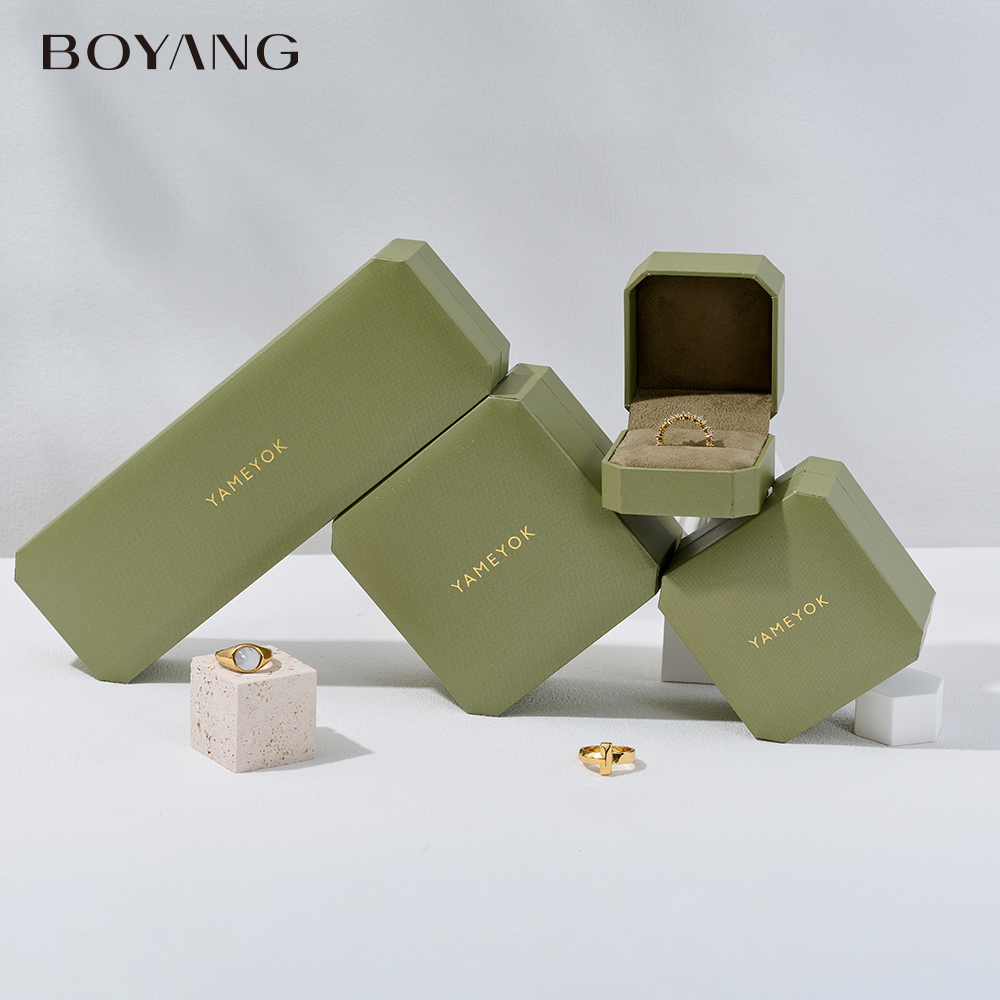
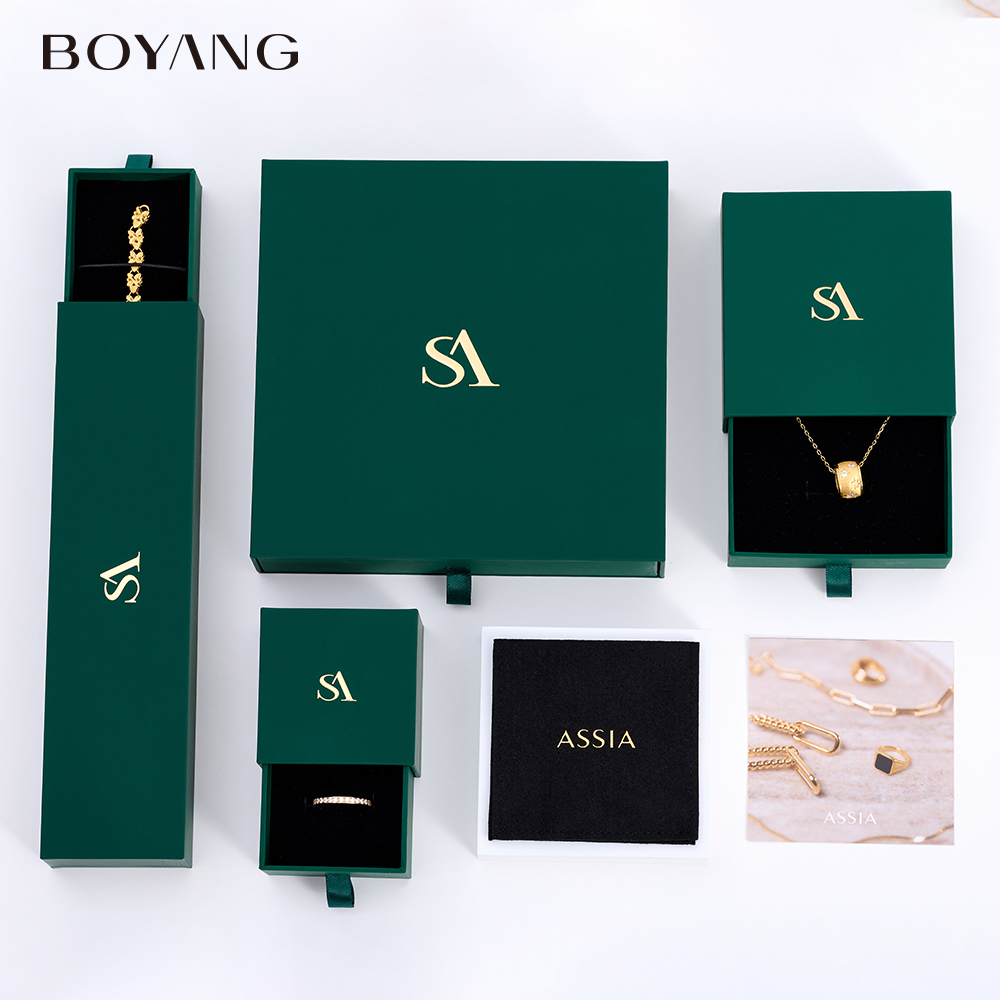
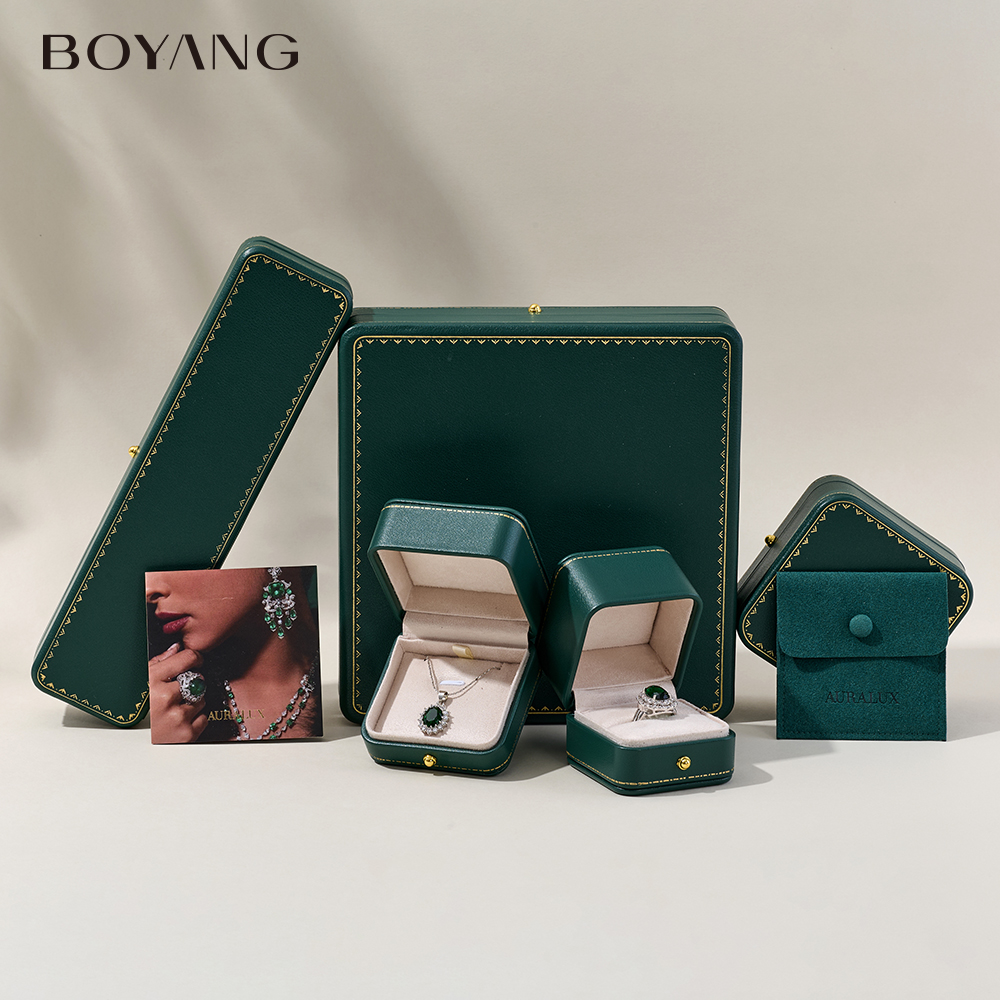
On the design your own jewelry packaging product example, several green boxes share a visual language while their shapes differ. Use it to discuss a possible family, then confirm the exact materials, sizes, inserts, finish, and logo method for your own order. A catalog image is a conversation starter, not an approved specification.
Request a quote that lists the box, insert, bag or pouch if needed, sampling, setup, packing, and delivery terms separately. Confirm minimum order, production timing, and any material or environmental statement directly for the proposed design. Do not assume a style shown online is available with every combination of features or in the quantity required.
Common Questions About Designing Jewelry Packaging
Can I start with a photograph of packaging I like?
Yes. Label the particular features you like, such as the opening, color, or proportion, and explain how they relate to your jewelry. Do not ask a supplier to copy another brand's artwork. A photograph cannot show internal fit or material behavior, so use it to begin a brief and then test a sample made for your product.
Should the box or the artwork be designed first?
Set the product fit and basic structure before finalizing artwork placement. A logo that looks centered in a flat mockup may move visually when the box is assembled or opened. Ask for the current dieline or structure template, then place the graphics and check a physical sample. Brand direction can be chosen early, but production artwork must match the selected format.
How many packaging concepts should a brand sample?
Sample enough to resolve the real design uncertainty, not every attractive variation. Compare a small shortlist against the same fit, opening, appearance, and packing criteria. If one structure already works, a targeted insert or artwork revision may be more useful than a new concept. Sampling scope and cost need confirmation with the supplier.
Can one visual design cover different jewelry types?
Often the exterior colors and logo treatment can be related across formats, while each box and insert are adjusted for the piece. Test rings, necklaces, earrings, or bracelets with their actual components. A shared appearance does not mean every product should use the same internal dimensions or retention method.
What should be approved before placing an order?
Approve the current specification, artwork, color reference, physical sample, and packing sequence with the actual jewelry. Confirm the quotation reflects those versions and identifies any optional component. Resolve material, minimum order, sampling, production, inspection, and delivery questions for the particular project before release.
Bring a supplier a clear design problem and a testable brief. When the sample solves the jewelry's fit and opening needs while expressing the chosen brand direction, the team has a practical basis for approving the packaging.
 Jewelry Packaging Boxes for Retail and Online Orders
Jewelry Box Made in China: What Overseas Buyers Should Verify
Jewelry Box Made in China: What Overseas Buyers Should Verify
Nov 07,2026
Custom Jewelry Boxes Bulk: Plan Quantity, Storage, and Reorders
Nov 04,2026
Custom Jewelry Box Manufacturer: Control the Design Handoffs
Nov 02,2026
Jewellery Packaging Boxes: Choose a Range That Fits Every Piece
Oct 30,2026
Customized Jewelry Box: Fit, Finish, and Practical Design Choices
Oct 28,2026
 You May Also Like



 Tel
 Email
 Address
Bldg 5,Zhenbao Industrial Zone Longhua,Shenzhen,China

Boyang Packing
 Whatsapp