Inquire (

 HOME
Jewellery Packaging Boxes: Choose a Range That Fits Every Piece
 Oct 30,2026

 BOYANGPACK
Jewellery packaging boxes work best as a planned range, with each box sized for its piece and designed for the same brand experience. A ring, pendant, and bracelet may need different inserts and proportions even when their exterior colors and finishing belong to one family. Buyers should decide what must stay consistent across the range and what must change to protect and present each item.
Start With the Jewelry, Not the Box Catalog
Begin with the products that will actually go into the boxes. Record the longest, widest, and tallest dimensions of each piece as it will be packed, including any chain, clasp, card, or protective sleeve. A box selected from its exterior photograph alone may look appropriate while leaving a pendant loose or forcing a bracelet into an awkward shape.
Group products by how they must be held, rather than by merchandise category alone. A delicate chain needs a way to control tangling; a ring needs a secure opening that presents its face; a pair of earrings needs both pieces held in the correct orientation. Two necklaces of similar size can still require different layouts if one has a large pendant or an unusually long chain.
Define the route after packing. A retail counter may emphasize the moment of opening, while an online order must also survive handling inside a shipping carton. The presentation box is only one layer of an ecommerce pack. Confirm whether the box is intended for shelf display, gifting, storage, or shipment before comparing structures.
Build a Coherent Range Without Identical Boxes
A coordinated range does not require every box to share the same footprint. It requires a repeatable visual system: color, logo placement, surface character, and the relationship between exterior and insert. Set these shared elements first, then allow the dimensions and insert geometry to change where the jewelry demands it.
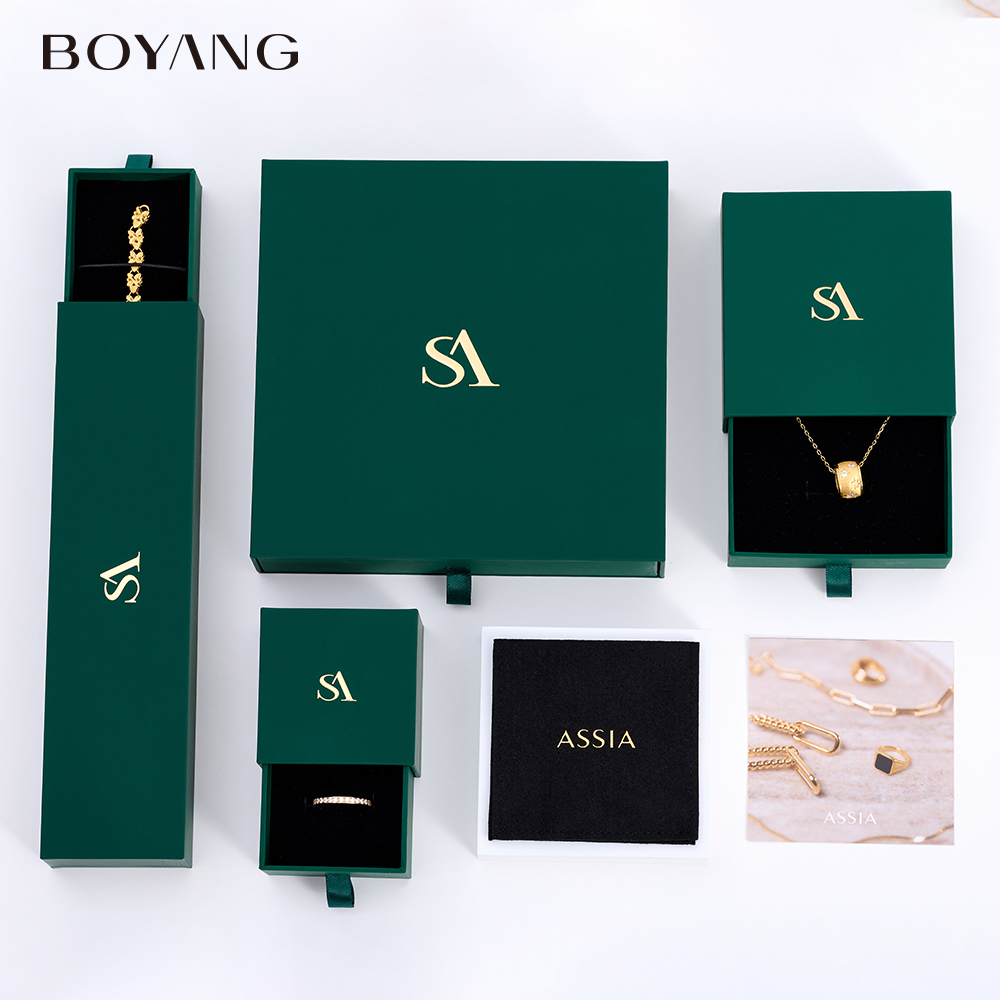
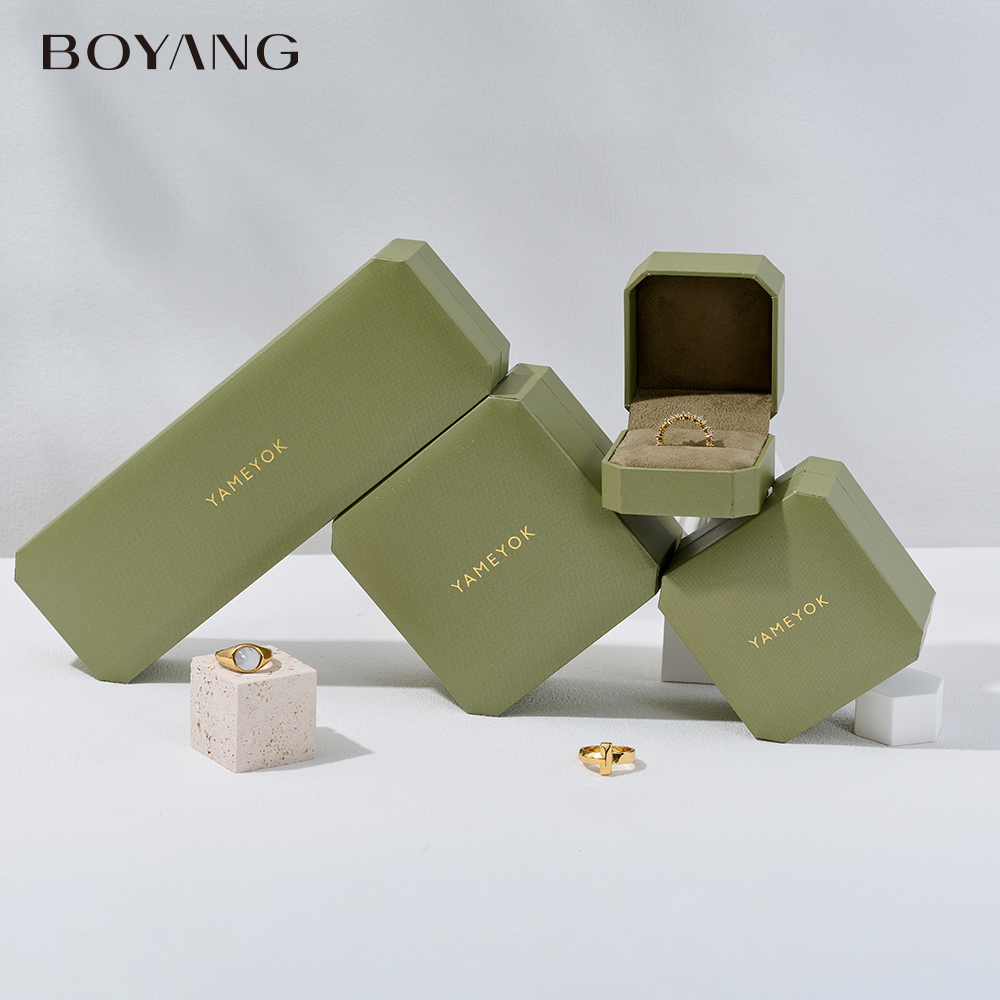
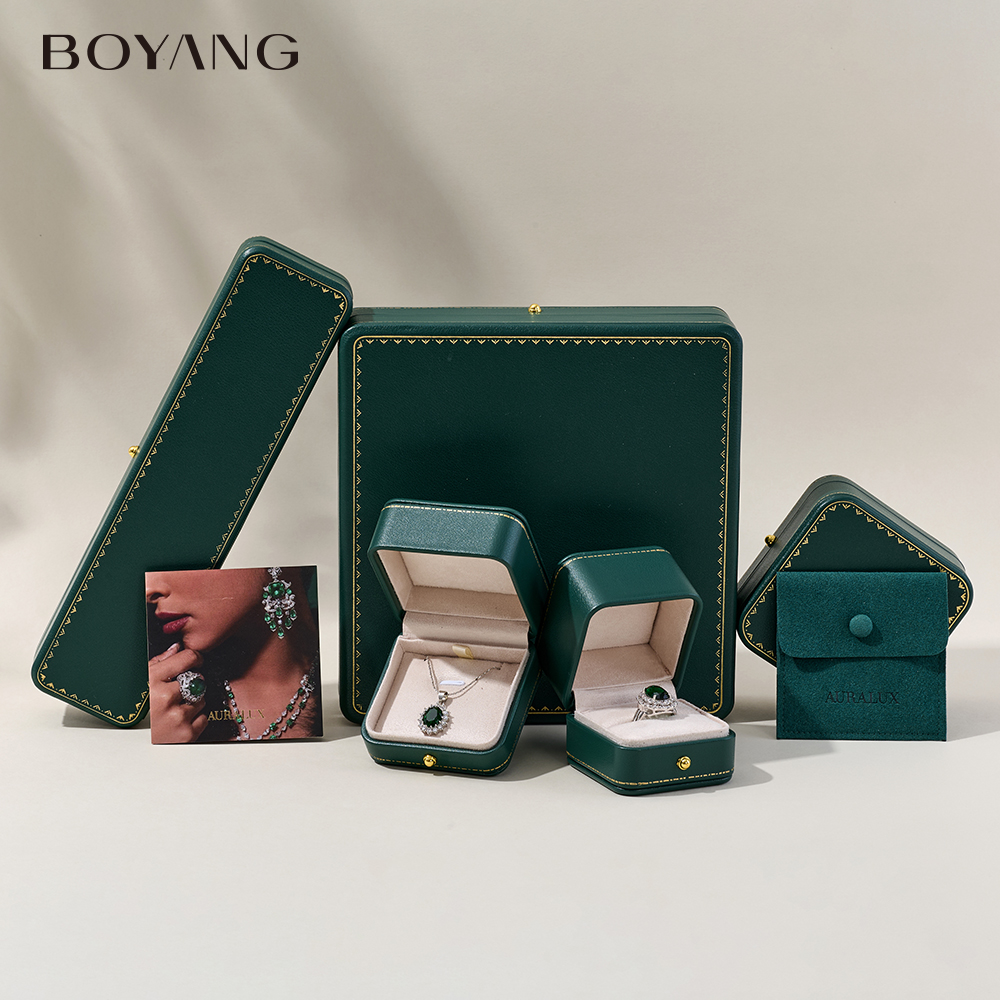
Consider the image below as an example of a visual family, not a specification for every product. Its green boxes use related color and decoration across different shapes, while the visible interiors and openings vary. The photograph establishes a design direction; it cannot establish fit for a buyer's own pieces or prove a material, finish, or production tolerance.
Decide how many box formats the collection truly needs. Too few can create empty space or compromise display; too many increase artwork, sampling, inventory, and reorder complexity. Start with product groups that share a practical insert and presentation, then split a group only when a fitting test shows a meaningful difference.
Match Box Structure and Insert to Each Piece
The box body, lid or drawer, and insert must be evaluated together. A well-sized exterior cannot compensate for an insert that releases the item when the box is tilted. Likewise, a secure insert can still produce a poor opening experience if the jewelry sits too deep or a chain catches under the lid.
| Product group | Fit question | Sample check |
|---|---|---|
| Ring | Does the opening hold different band shapes without twisting? | Insert and remove the intended ring repeatedly, then tilt the closed box. |
| Necklace or pendant | Where do the chain and clasp rest? | Pack the full chain and inspect it after opening. |
| Earrings | Can both pieces remain aligned and separated? | Close, move, and reopen the box with the actual pair. |
| Bracelet | Does its curve or length fit naturally? | Check contact points and whether the clasp stays controlled. |
Ask for the proposed insert material and construction, then judge the finished sample with actual jewelry. A supplier may offer paperboard, foam, fabric covered, or other insert approaches, but the right choice depends on the piece, its finish, and the intended presentation. Avoid assuming that a soft-looking surface is suitable for every metal, coating, or stone. Where material compatibility matters, confirm it with the jewelry team and the supplier.
Test the Complete Presentation Before Ordering
Review a physical sample in the order the customer will experience it: take it from the outer pack, examine the closed box, open it, lift the jewelry, and put it back. Look for rubbing, trapped chains, awkward finger access, lid resistance, loose parts, or an insert that rises with the jewelry. This sequence often reveals issues that flat artwork and product photographs cannot.
Check the range side by side. Print color, logo position, edge treatment, and insert color can appear consistent in separate approvals but diverge when the formats are displayed together. Record an approved reference for each format and make clear which details are shared. If the launch includes a bag, card, or pouch, test those with the boxes as a complete packing sequence.
For shipped orders, place the sample box inside the intended protective outer pack and assess how it is restrained. The display box may need extra cushioning or a different carton arrangement. A supplier's attractive presentation photo does not validate the full shipping system, so the buyer should define and test that system for its own distribution route.
Prepare a Brief a Supplier Can Act On
A useful request separates fixed brand decisions from choices that still need development. Provide product measurements, photographs of the jewelry, the intended packing position, quantity by format, target market, and examples of the desired visual language. State whether each box will be used in store, sent as a gift, or shipped directly to a customer.
Request a proposal that identifies each box format and its matching insert, rather than one generic quotation for the whole collection. Ask which artwork and color references the supplier needs, which elements can be shared across formats, and which require separate tools or approvals. This makes the cost and complexity of a coordinated range easier to review without assuming a particular price or minimum order.
Use a real sample to approve fit, opening, appearance, and packing before committing to production. If you are still deciding between a complete set and individual formats, compare the options on the jewellery packaging boxes product example, then ask the supplier to confirm what can be adapted for your products. Confirm materials, finishes, sampling terms, minimum order quantities, production timing, inspection, and shipping arrangements for the specific project.
Common Questions About Jewellery Packaging Boxes
Should every jewelry item use the same box size?
No. A common color and finish can connect a range even when dimensions differ. Choose formats around the actual pieces and their inserts, then check the boxes together for a consistent visual effect. A single large format may simplify purchasing, but excess empty space can weaken presentation and increase the outer pack required for delivery.
What should a buyer send before requesting samples?
Send the jewelry's packed dimensions, clear photographs, intended orientation, brand artwork, desired colors, and the planned use of each box. Include the product groups and estimated quantity by format. The supplier can then propose structures and inserts against a real brief; sampling terms and feasibility still need direct confirmation.
Can one insert work for several jewelry styles?
Sometimes, but test it with every intended style. A ring slot that holds one band may distort another, and a necklace layout may leave a different pendant unstable. Shared inserts can reduce complexity only when they preserve fit and presentation across the entire group. Keep the approval tied to the actual products tested.
Does a presentation box replace shipping protection?
Usually the presentation box is only part of the shipping pack. Its job is to hold and present the jewelry; the outer carton and cushioning must address transport handling. Test the finished combination using your distribution method. The required level of protection depends on the box structure, jewelry, route, and handling conditions.
How can a buyer keep a multi-format range consistent?
Approve shared references for color, logo placement, finish, and insert appearance, while documenting each format's dimensions and fitting method separately. Compare physical samples together under the same lighting. Keep approved samples and artwork files available for later reorders, and confirm any material or process change before the next run.
The strongest box range starts with the jewelry and ends with an approved packing experience. Send a format-by-format brief and actual pieces for sampling, then confirm the commercial and production details against the approved designs.
 Custom Jewelry Box Manufacturer: Control the Design Handoffs
Customized Jewelry Box: Fit, Finish, and Practical Design Choices
Customized Jewelry Box: Fit, Finish, and Practical Design Choices
Oct 28,2026
Custom Jewelry Packaging for Small Business: Start With Less
Oct 21,2026
Jewellery Packaging Manufacturers: Coordinating a Complete Brand Set
Oct 17,2026
Jewellery Box Manufacturers: Match Capability to Your Design
Oct 14,2026
 You May Also Like



 Tel
 Email
 Address
Bldg 5,Zhenbao Industrial Zone Longhua,Shenzhen,China

Boyang Packing
 Whatsapp