Inquire (
 HOME
HOMEWhat Determines the Cost of Custom Jewelry Boxes?
 Jun 28,2026

 BOYANGPACK
The unit price of Custom Jewelry Boxes is determined by five primary manufacturing factors: paper material selection (kraft, coated art, or specialty paper), box structure complexity (two-piece, drawer, or magnetic), printing and surface finishes (CMYK, foil stamping, embossing), interior insert type (EVA, velvet, foam), and total order volume. Higher-order volumes significantly reduce the cost per unit by distributing fixed factory setup fees across a larger quantity.
For jewelry brands and retailers, understanding these variables is critical for balancing packaging aesthetics with procurement budgets. Below is a detailed breakdown of how each component impacts your final quote.
1. Material Selection: The Baseline Cost
Raw material dictates the foundation of your unit price. Because paper comes in various grades, weights, and textures, your selection has an immediate impact on the budget.
Kraft Paper: A highly cost-effective and eco-friendly option. It is ideal for sustainable brands and high-volume e-commerce shipping.
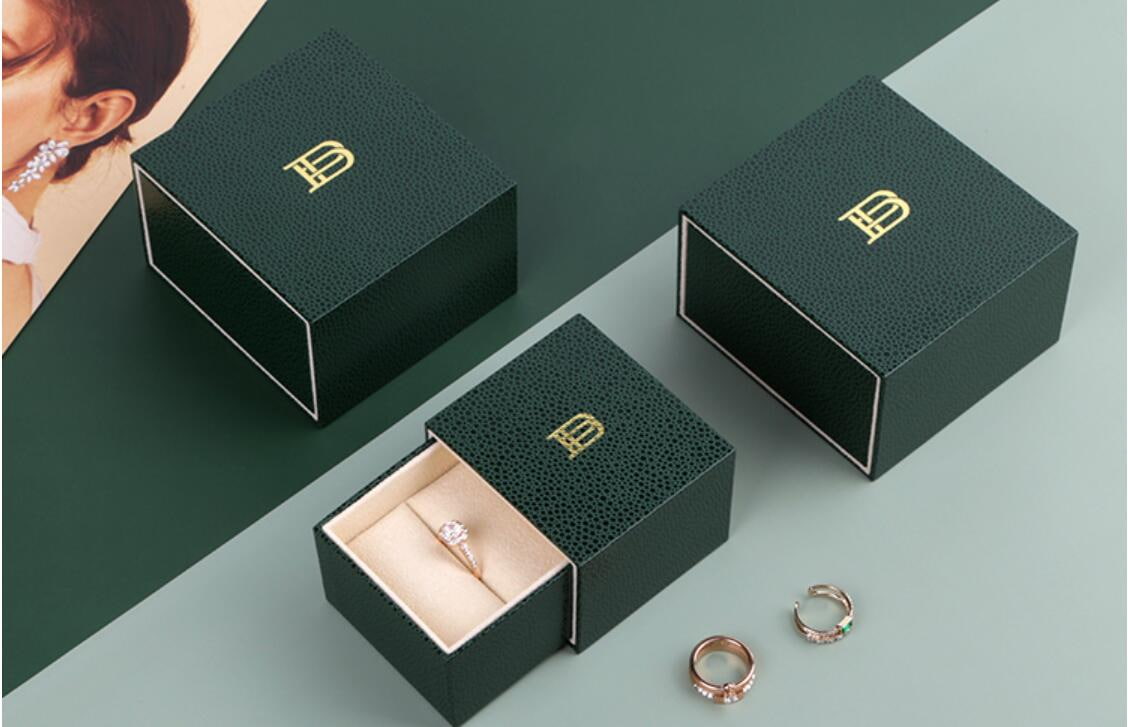
Coated Art Paper: The standard for most custom-printed boxes. It is usually mounted on rigid cardboard, offering a smooth surface for full-color printing at a moderate cost.
Specialty/Textured Paper: Manufactured with specific textures (such as leather-look, metallic, or linen). These papers cost significantly more per sheet but require less printing, making them suitable for luxury boutiques.
| Material Type | Relative Cost | Best Suited For |
| Kraft Paper | Low | Sustainable brands, minimalist designs, e-commerce |
| Coated Art Paper | Medium | Brands requiring full-color CMYK printing and complex graphics |
| Textured Paper | High | Luxury boutiques, high-end bridal jewelry, premium collections |
2. Box Structure and Assembly Labor
The physical shape of your jewelry box directly affects manufacturing time. Complex structures require more manual labor or specialized machine setup for folding and gluing.
Two-Piece Box (Lid and Base): The most traditional rigid structure. It requires standard gluing processes and is fast to produce, keeping labor costs low.
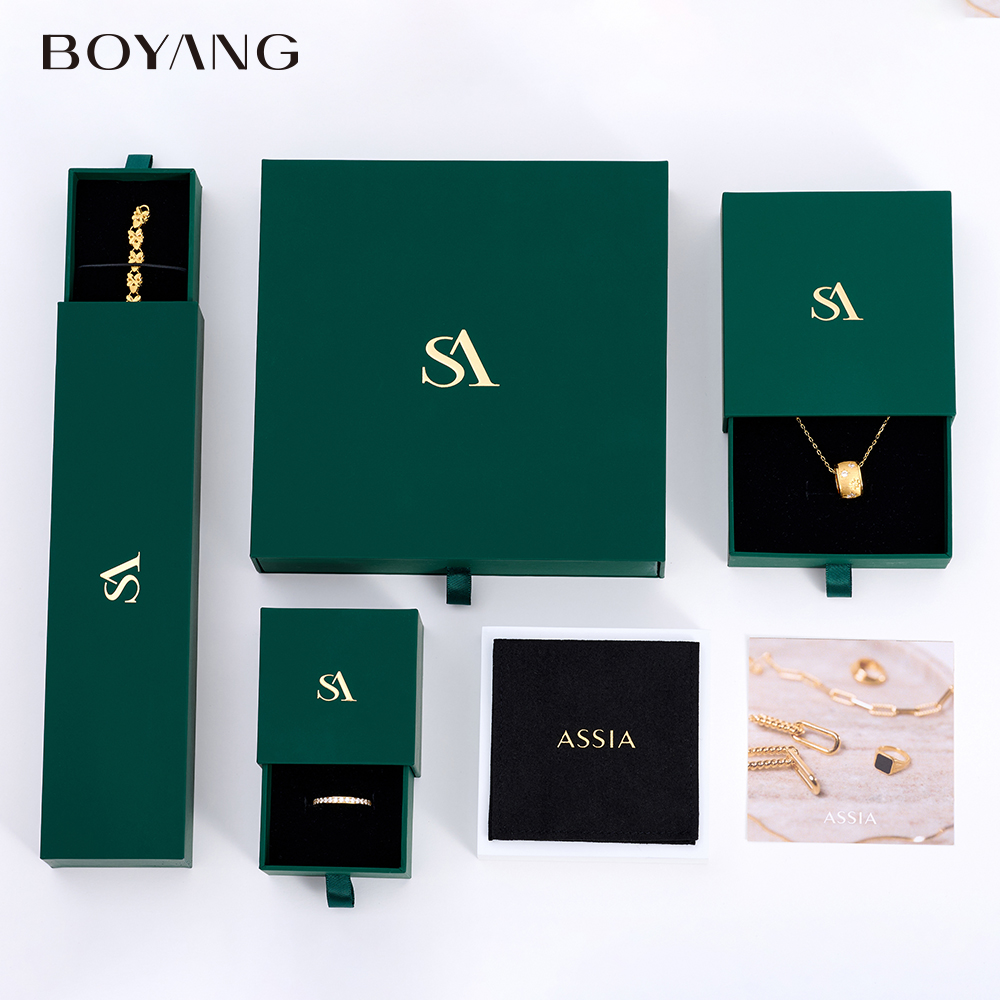
Drawer Box (Slide-Out): Features an outer sleeve and an inner sliding tray. The precise folding required to ensure smooth sliding adds a slight premium to the cost.
Magnetic Closure Box: Features a hinged lid with hidden magnets. The cost of the magnets and the precise labor needed to conceal them within the rigid board make this a higher-priced structural option.
3. Printing and Surface Finishing
Branding elements add visual value but require separate machinery, tooling (like copper dies for stamping), and setup time.
Printing (CMYK vs. Pantone): Standard full-color (CMYK) printing is economical. Specifying a Pantone color to ensure exact consistency across a complete jewelry packaging set requires custom ink mixing, which increases the price.
Hot Foil Stamping: Applying metallic foil (gold, silver, etc.) requires custom metal molds. It adds a moderate cost per unit but offers a high-end look.
Embossing/Debossing: Pressing the logo into the paper requires a custom die.
Spot UV: Applying a high-gloss finish to specific areas over a matte background.
Cost-saving tip: If working with a strict budget, combining standard coated paper with a single-color print or a simple foil-stamped logo provides a premium feel without stacking finishing costs.
4. Interior Inserts
Buyers often overlook the insert when calculating budgets. The material that holds the jewelry securely in place varies widely in price.
Cardboard/Paper: Die-cut paper is the most affordable and environmentally friendly option.
Sponge/Foam: Cost-effective and provides excellent shock absorption for shipping.
EVA Foam: Denser and more rigid. It holds sharp, clean cutouts and looks more professional than standard foam, costing slightly more.
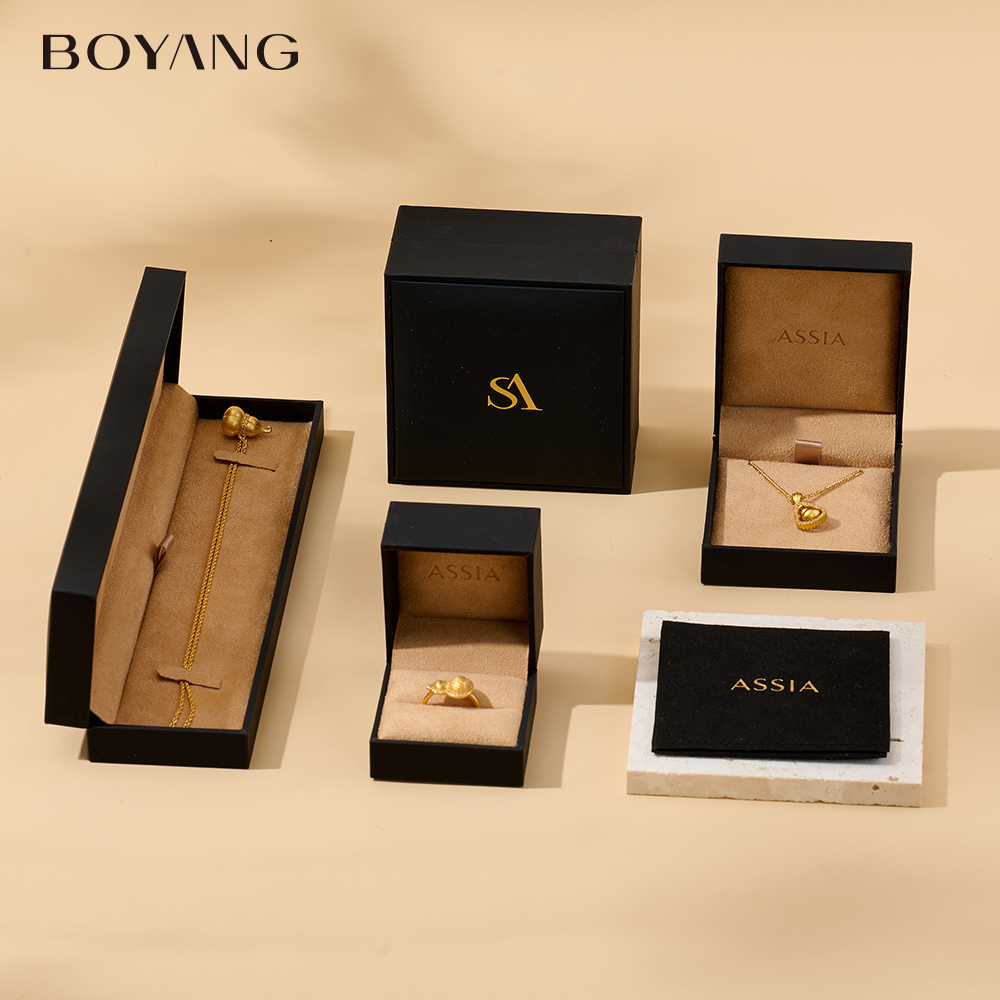
Velvet/Flocking: Applying velvet over EVA or plastic molds provides a soft, luxurious touch. It is the most expensive insert option due to both material and assembly costs.
5. Order Volume (MOQ)
In B2B packaging manufacturing, volume is the strongest lever for price negotiation. Setup costs—creating cutting dies, printing plates, and machine calibration—are fixed.
If you order 1,000 boxes, the fixed setup cost is divided among those 1,000 units. If you order 10,000 boxes, the setup cost per unit becomes fractional. When requesting a quote, ask for pricing across multiple tiers (e.g., 3,000, 5,000, and 10,000 units) to find the most cost-effective procurement volume for your business.
Why Factory Capabilities Matter for Cost Control
Working directly with an established manufacturer eliminates middleman markups and guarantees consistent quality. Since 2004, we have operated as a dedicated jewelry packaging design and manufacturing facility.
Our 12,000-square-meter plant houses over 300 employees, including 10 R&D specialists and a 36-person quality inspection team. With a daily production capacity of 150,000 paper boxes and 180,000 plastic boxes, we possess the scale required to offer highly competitive unit pricing.
Furthermore, our entire production process is certified by ISO9001, BV, and SGS. This ensures that cost efficiency does not come at the expense of material safety or structural integrity.
Buyer Checklist: Preparing for a Quote
To receive an accurate price from the engineering team quickly, prepare the following specifications:
[ ] Dimensions: Internal and external measurements (Length × Width × Height).
[ ] Structure: Two-piece, drawer, or magnetic closure.
[ ] Material: Kraft, coated art paper, or specialty paper.
[ ] Insert: Foam, EVA, velvet, or paper board (specify the jewelry type).
[ ] Finishing: Print colors, foil stamping, or embossing needs.
[ ] Target Quantity: Estimated order volume.
Ready to optimize your packaging budget? Visit our home page to explore our manufacturing capabilities, or contact our engineering team today to request a quote and physical samples.
4. FAQ
What is the standard production time for custom paper jewelry boxes?
Production timelines depend on the structural complexity and volume. Typically, mass production takes [Need user input: insert standard lead time, e.g., 15-20 days] after final sample approval.
Does adding a foil-stamped logo drastically increase the price?
Foil stamping adds a marginal unit cost and requires a one-time setup fee for the metal die. For volume orders, the impact on the per-unit price is very low, making it an efficient way to achieve a luxury appearance.
Can I get a custom sample before placing a bulk order?
Yes. A professional factory will produce a pre-production sample based on your specifications. This allows you to verify material quality, print accuracy, and insert fit before committing to mass production.
How can I reduce my packaging costs without losing the high-end look?
Simplify the box structure (e.g., select a two-piece lid-and-base over a magnetic closure) and consolidate your packaging sizes. Using a high-quality standard paper with a single foil-stamped logo often looks more premium than complex, multi-finish designs.
 5 Signs You’ve Found a Reliable Jewelry Box Manufacturer in China
Giving Bespoke Jewelry Boxes a "Second Life": Reimagining Home Aesthetics
4 Tips to Acquire New Customers Fast!
Jun 20,2022
How to choose a jewelry pendant box? What are the requirements for a custom design?
May 30,2022
What are the advantages of cardboard jewelry boxes?
Apr 23,2022
 You May Also Like

 Tel
Tel
 Email
Email
 Address
Bldg 5,Zhenbao Industrial Zone Longhua,Shenzhen,China

Boyang Packing
 Whatsapp